Doing a leg exercise while sitting down, which works a muscle in your calf, lowers the amount of sugar and insulin in your blood after you eat by about half in healthy people.
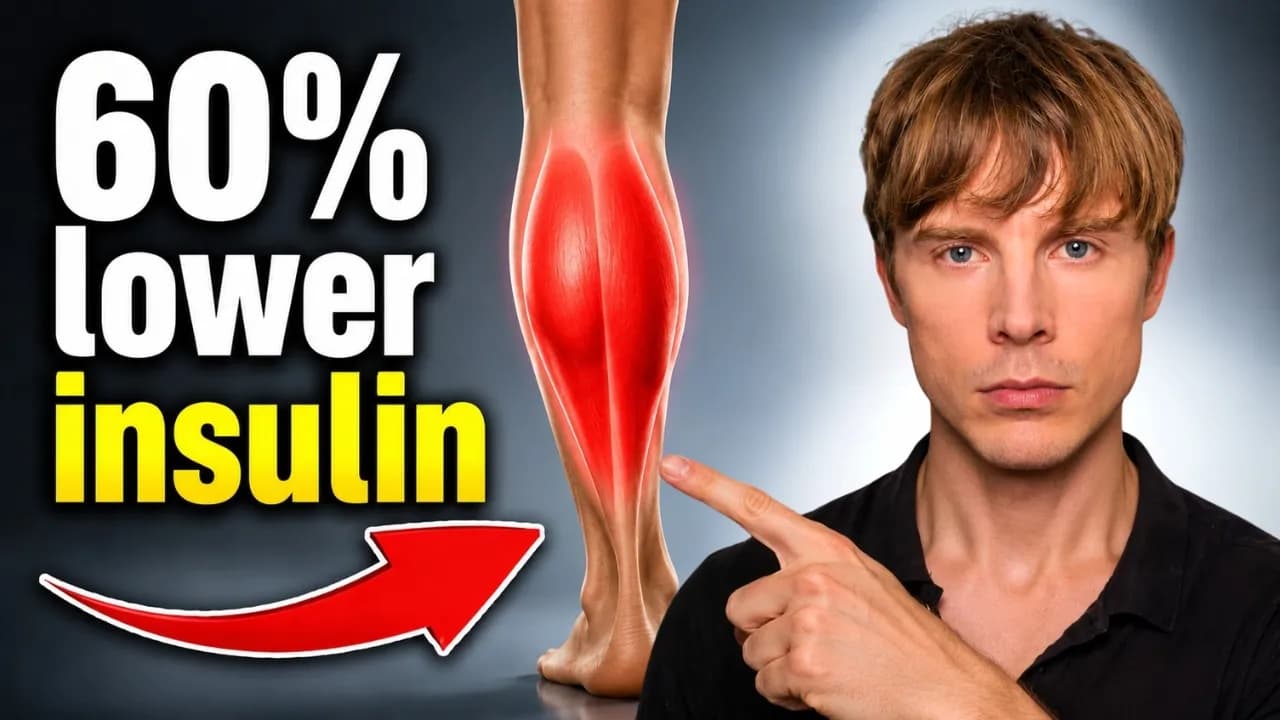 From Your Second Heart Is Destroying Your Metabolism · video
See the scientific wording
Seated calf raises that activate the soleus muscle reduce post-meal blood glucose by 52% and insulin response by 60% in healthy adults.
Very strong evidence
Randomized trialsOne moderate-quality study supports this claim, so treat this as an early signal rather than settled science.
What the research says
1 study reviewedSupporting (1)
Randomized Controlled TrialHuman2022
The study showed that doing seated calf raises reduces blood sugar and insulin spikes after a meal by about half, just like the claim says.
Contradicting (0)
No contradicting studies found yet
That doesn't mean it's settled — it just means no study has tested the opposite.
Quality-weighted scoring: we follow the GRADE framework — each study is rated High, Moderate, Low, or Very Low based on study design, methodology rigor, and risk of bias. A single high-quality RCT can outweigh several weaker observational studies.
Scores reflect study quality, not just count.
When you do seated calf raises, a muscle in your calf (the soleus) gets active. This muscle is different from others because it uses oxygen to burn sugar from your blood for energy. When this muscle works steadily, it takes up a lot of sugar from your blood, so after you eat, your blood sugar doesn't go up as much. Because your blood sugar stays lower, your body doesn't need to release as much insulin. That's why your insulin response is lower.
Score breakdown, mechanism chain, raw evidence, ideal studies needed & 1 supporting study
How Fit Body Science checks a claim
- 1
We isolate the claim
Health advice from videos, articles and studies is broken down into single, testable claims.
- 2
We find the research
Each claim is matched against peer-reviewed studies, with every source cited by DOI.
- 3
We grade the evidence
Studies are scored on methodology, statistical rigor, transparency and publication quality.
The fitness and health internet is full of confident claims. We check them against real research.
Every claim on this site is traced back to peer-reviewed studies, scored on methodology and reporting quality, and given a verdict you can audit yourself — sources, DOIs and all.
- Full evidence breakdown and mechanism chains
- Ask our AI anything about a claim or its studies
- Get notified when new research changes a verdict
Doing a leg exercise while sitting down, which works a muscle in your calf, lowers the amount of sugar and insulin in your blood after you eat by about half in healthy people.
Mechanism
1 studySeated calf raises activate a special muscle that uses a lot of sugar from your blood for energy. This keeps your blood sugar from spiking after meals, so your body needs to make less insulin. The effect is strong because this muscle is designed for steady, low-effort work.
When you do seated calf raises, a muscle in your calf (the soleus) gets active. This muscle is different from others because it uses oxygen to burn sugar from your blood for energy. When this muscle works steadily, it takes up a lot of sugar from your blood, so after you eat, your blood sugar doesn't go up as much. Because your blood sugar stays lower, your body doesn't need to release as much insulin. That's why your insulin response is lower.
Sustained low-intensity contractions activate the soleus muscle, which is predominantly composed of slow-oxidative (type I) muscle fibers.
Activation of the soleus muscle increases its oxidative metabolism and oxygen consumption.
The elevated metabolic demand increases the muscle's uptake and oxidation of blood-borne glucose.
The soleus muscle relies minimally on its internal glycogen stores, sparing glycogen and further promoting glucose uptake from the blood.
The enhanced glucose clearance reduces the postprandial rise in blood glucose.
The reduced blood glucose levels lead to decreased pancreatic insulin secretion, lowering the insulin response.
Evidence from Studies
Last searched 1mo ago
Supporting (1)
Community contributions welcome
A potent physiological method to magnify and sustain soleus oxidative metabolism improves glucose and lipid regulation
The study showed that doing seated calf raises reduces blood sugar and insulin spikes after a meal by about half, just like the claim says.
Contradicting (0)
Community contributions welcome
Score Breakdown
No multi-axis breakdown available yet. The overall Pro / Against score above is the best signal.
- No clinical evidence is available; the score reflects mechanistic plausibility only.
What Would Prove This
Per GRADE and EBM methodology, here is what ideal scientific evidence would look like to definitively prove or disprove this claim, ordered from strongest to weakest.
Systematic Review and Meta-Analysis of Seated Calf Raise Interventions on Postprandial Glycemia and Insulinemia in Healthy Adults
Systematic review of randomized controlled trials that compare seated calf raise exercise to control conditions (e.g., sitting or other exercise) in healthy adults, measuring postprandial glucose and insulin responses over a defined time.
Randomized Controlled Trial of Seated Calf Raises vs Control on Post-Meal Blood Glucose and Insulin in Healthy Adults
Randomize healthy adults to either a seated calf raise protocol (e.g., 30 minutes of calf raises immediately after a standardized meal) or a control group (sitting without exercise). Measure blood glucose and insulin at multiple timepoints post-meal (e.g., 0, 30, 60, 90, 120 min) for a duration of at least one day (possibly multiple sessions).
Prospective Cohort Study on Habitual Seated Calf Raise Practice and Postprandial Glucose and Insulin Responses in Healthy Adults
Follow a group of healthy adults who self-report doing seated calf raises regularly compared to a group that does not, and measure postprandial glucose and insulin responses at baseline and over a period (e.g., 6 months to years) to see if differences emerge.
Cross-Sectional Study of Soleus Muscle Activation and Postprandial Glucose/Insulin in Healthy Adults
Measure soleus muscle activation during daily activities and assess postprandial glucose and insulin responses in a sample of healthy adults at a single point in time, comparing those with high versus low activation or exercise frequency.