When people gain the same amount of weight, consuming fructose results in more fat accumulating around internal organs than consuming glucose.
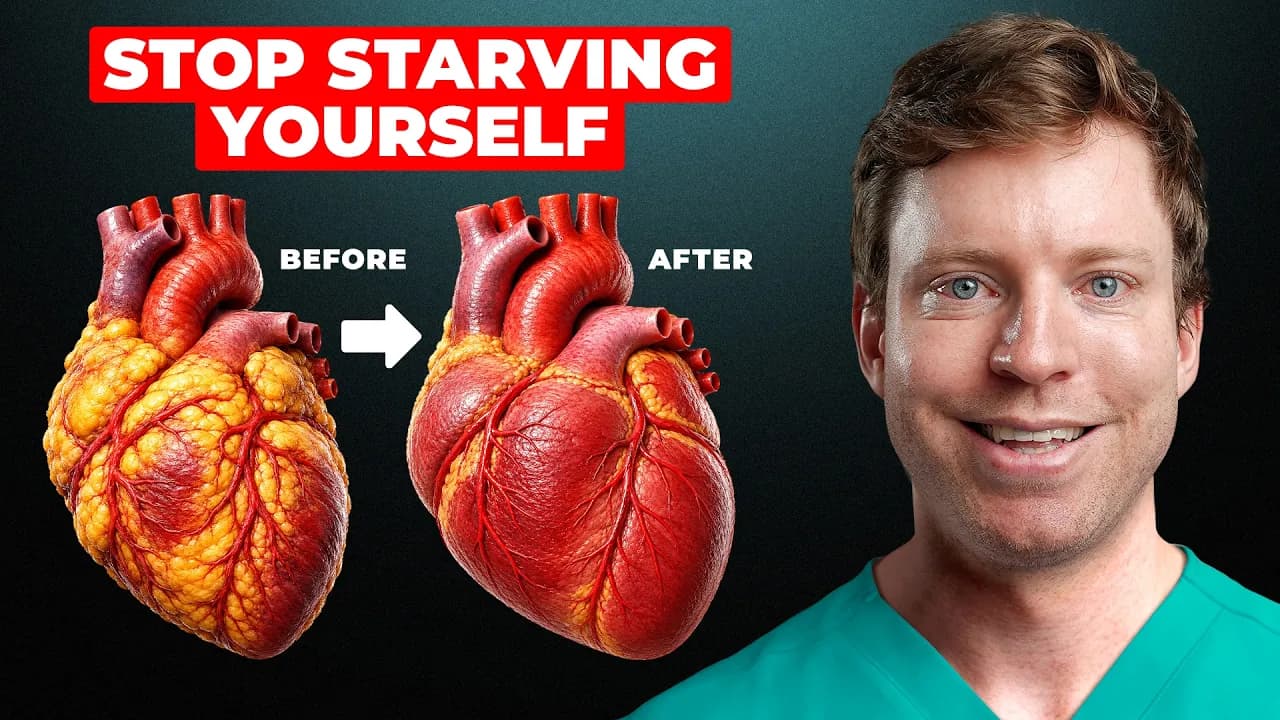 From Shrink the Fat Around Your Heart · video
See the scientific wording
When weight gain is held constant, fructose consumption leads to greater visceral fat accumulation than glucose consumption.
Correlational — new studies may shift this
ObservationalOne low-scoring study links this claim to the outcome, but causation is not established.
What the research says
1 study reviewedSupporting (1)
Cohort StudyAnimal2015
When mice ate lots of fructose, they got fat around their organs — but if scientists blocked a specific enzyme needed to process fructose, the mice stayed lean even eating the same fructose. This suggests fructose is uniquely bad for belly fat compared to other sugars.
Contradicting (0)
No contradicting studies found yet
That doesn't mean it's settled — it just means no study has tested the opposite.
Quality-weighted scoring: we follow the GRADE framework — each study is rated High, Moderate, Low, or Very Low based on study design, methodology rigor, and risk of bias. A single high-quality RCT can outweigh several weaker observational studies.
Scores reflect study quality, not just count.
When fructose is consumed, it is processed in fat tissue around the organs by a specific enzyme that drains energy from cells and creates harmful byproducts. This triggers inflammation and stress in the fat cells, which stops them from releasing a key hormone that helps burn fat. Without this hormone, fat keeps accumulating in the belly area instead of being used for energy.
Score breakdown, mechanism chain, raw evidence, ideal studies needed & 1 supporting study
How Fit Body Science checks a claim
- 1
We isolate the claim
Health advice from videos, articles and studies is broken down into single, testable claims.
- 2
We find the research
Each claim is matched against peer-reviewed studies, with every source cited by DOI.
- 3
We grade the evidence
Studies are scored on methodology, statistical rigor, transparency and publication quality.
The fitness and health internet is full of confident claims. We check them against real research.
Every claim on this site is traced back to peer-reviewed studies, scored on methodology and reporting quality, and given a verdict you can audit yourself — sources, DOIs and all.
- Full evidence breakdown and mechanism chains
- Ask our AI anything about a claim or its studies
- Get notified when new research changes a verdict
When people gain the same amount of weight, consuming fructose results in more fat accumulating around internal organs than consuming glucose.
Mechanism
1 studyFructose is broken down in belly fat by a special enzyme that drains energy and creates stress, which shuts down a hormone that normally helps burn fat. Without that hormone, fat builds up in the belly. Glucose doesn't do this because it uses a different breakdown path.
When fructose is consumed, it is processed in fat tissue around the organs by a specific enzyme that drains energy from cells and creates harmful byproducts. This triggers inflammation and stress in the fat cells, which stops them from releasing a key hormone that helps burn fat. Without this hormone, fat keeps accumulating in the belly area instead of being used for energy.
Fructose is taken up by visceral adipocytes and phosphorylated by ketohexokinase to fructose-1-phosphate
Ketohexokinase-mediated fructose metabolism depletes intracellular ATP and generates uric acid, inducing oxidative stress
Oxidative stress and metabolic stress activate proinflammatory signaling and endoplasmic reticulum stress in visceral adipose tissue
Endoplasmic reticulum stress and inflammation suppress the production and secretion of high-molecular-weight adiponectin from adipocytes
Reduced high-molecular-weight adiponectin impairs AMPK activation, decreasing fatty acid oxidation and increasing insulin resistance
Decreased fatty acid oxidation and increased insulin resistance promote net lipid storage in visceral adipose tissue
Evidence from Studies
Last searched 2mo ago
Supporting (1)
Community contributions welcome
When mice ate lots of fructose, they got fat around their organs — but if scientists blocked a specific enzyme needed to process fructose, the mice stayed lean even eating the same fructose. This suggests fructose is uniquely bad for belly fat compared to other sugars.
Contradicting (0)
Community contributions welcome
Score Breakdown
No multi-axis breakdown available yet. The overall Pro / Against score above is the best signal.
Clinical support requires direct evidence. Mechanistic proxy and tangential studies contribute only to the mechanistic score.
- All linked studies are tangential or mechanistic proxies — no direct test of the claim has been found.
- No clinical evidence is available; the score reflects mechanistic plausibility only.
What Would Prove This
Per GRADE and EBM methodology, here is what ideal scientific evidence would look like to definitively prove or disprove this claim, ordered from strongest to weakest.
Systematic Review and Meta-Analysis of Isocaloric Fructose vs. Glucose Feeding on Visceral Fat in Humans
Population: Healthy adult humans; Intervention: Isocaloric diet with fructose as primary added sugar; Comparator: Isocaloric diet with glucose as primary added sugar; Outcome: Change in visceral fat mass measured by MRI or CT; Duration: 4–12 weeks.
Double-Blind, Isocaloric, Crossover Trial of Fructose vs. Glucose on Visceral Fat in Adults with Normal Weight
Population: Adults aged 18–65 with normal BMI; Intervention: 10% of daily calories from fructose-sweetened beverages; Comparator: 10% of daily calories from glucose-sweetened beverages; Outcome: Visceral fat change via MRI; Duration: 8 weeks; Design: Crossover with washout period.
Prospective Cohort Study of Fructose and Glucose Intake and Visceral Fat Accumulation Over 5 Years in Adults
Population: 5,000 adults aged 30–70; Intervention: Dietary intake assessed via food frequency questionnaires; Comparator: Group with highest fructose intake vs. highest glucose intake; Outcome: Visceral fat measured by DXA or CT at baseline and 5-year follow-up; Duration: 5 years.
Case-Control Study of Visceral Obesity and Dietary Fructose vs. Glucose Intake in Adults
Population: Cases with high visceral fat (MRI-defined); Controls with low visceral fat matched for age, sex, BMI; Intervention: Retrospective dietary recall of fructose and glucose intake over past year; Comparator: Fructose intake in cases vs. controls; Outcome: Odds ratio of high fructose intake in cases.
Cross-Sectional Analysis of Fructose Intake and Visceral Fat in a National Health Survey Population
Population: Representative sample from national health survey; Intervention: Self-reported fructose and glucose intake; Comparator: Individuals in highest vs. lowest quintile of fructose intake; Outcome: Visceral fat measured by bioimpedance or waist-to-hip ratio; Duration: Single time point.