When you exercise, your muscles make a substance called lactate. This lactate helps muscle cells move sugar transporters to their surface, so the muscle can absorb more sugar from your blood.
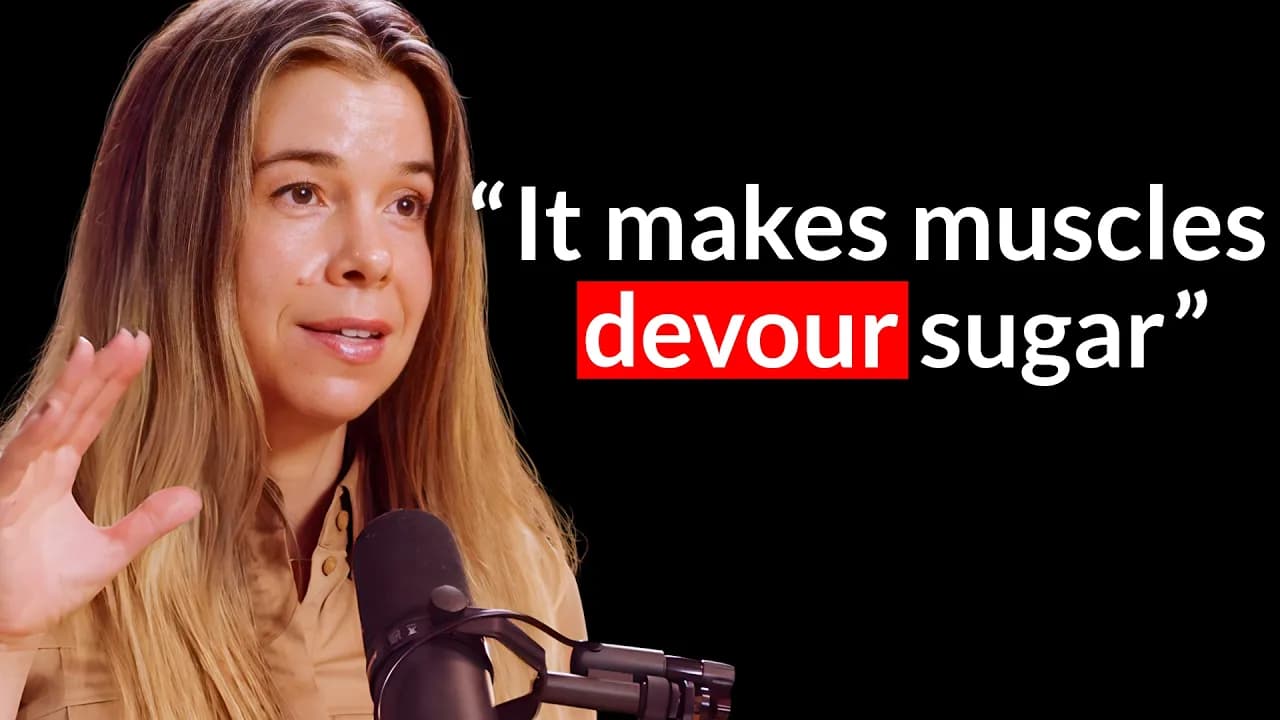
See the scientific wording
Lactate acts as a signaling molecule that induces the movement of GLUT4 transport proteins to the muscle cell membrane, thereby increasing glucose uptake into the muscle.
There's disagreement
ObservationalThe 2 studies we reviewed point in different directions — there's no clear consensus.
What the research says
2 studies reviewedSupporting (1)
Cross-Sectional StudyAnimal2026
The study found that lactate helps muscle cells move sugar transporters to their surface, just like the claim says.
Contradicting (1)
Cross-Sectional StudyAnimal2002
The study found that while lactate does move sugar transporters to the cell surface, the muscle actually absorbs less sugar, which is the opposite of what the claim says.
Quality-weighted scoring: we follow the GRADE framework — each study is rated High, Moderate, Low, or Very Low based on study design, methodology rigor, and risk of bias. A single high-quality RCT can outweigh several weaker observational studies.
Scores reflect study quality, not just count.
When muscles work hard, they make lactate. This lactate attaches to a special receptor on the muscle cell. That receptor sends a signal inside the cell that causes tiny packets of sugar transporters to move to the cell surface. These transporters then pull sugar from the blood into the muscle, giving it energy. This process doesn't need insulin, so it works even when insulin isn't around.
Score breakdown, mechanism chain, raw evidence, ideal studies needed & 1 supporting, 1 contradicting studies
How Fit Body Science checks a claim
- 1
We isolate the claim
Health advice from videos, articles and studies is broken down into single, testable claims.
- 2
We find the research
Each claim is matched against peer-reviewed studies, with every source cited by DOI.
- 3
We grade the evidence
Studies are scored on methodology, statistical rigor, transparency and publication quality.
The fitness and health internet is full of confident claims. We check them against real research.
Every claim on this site is traced back to peer-reviewed studies, scored on methodology and reporting quality, and given a verdict you can audit yourself — sources, DOIs and all.
- Full evidence breakdown and mechanism chains
- Ask our AI anything about a claim or its studies
- Get notified when new research changes a verdict
When you exercise, your muscles make a substance called lactate. This lactate helps muscle cells move sugar transporters to their surface, so the muscle can absorb more sugar from your blood.
Mechanism
2 studiesMuscles make lactate when they work. The lactate sticks to a receptor on the muscle, which tells the muscle to move sugar transporters to its edge so it can take in sugar from the blood. This helps the muscle get energy even without insulin.
When muscles work hard, they make lactate. This lactate attaches to a special receptor on the muscle cell. That receptor sends a signal inside the cell that causes tiny packets of sugar transporters to move to the cell surface. These transporters then pull sugar from the blood into the muscle, giving it energy. This process doesn't need insulin, so it works even when insulin isn't around.
Lactate binds to the GPR81 receptor on the surface of skeletal muscle cells.
GPR81 activation recruits the protein FARP1 to its cytoplasmic domain.
FARP1 acts as a guanine nucleotide exchange factor to activate the small GTPase RAC1.
Activated RAC1 promotes the translocation of GLUT4 vesicles from intracellular stores to the plasma membrane.
Increased cell-surface GLUT4 facilitates glucose uptake into the muscle cell, lowering blood glucose levels.
Evidence from Studies
Last searched 1mo ago
Supporting (1)
Community contributions welcome
Lactate-activated GPR81/FARP1 signaling drives insulin-independent glucose uptake and metabolic control
The study found that lactate helps muscle cells move sugar transporters to their surface, just like the claim says.
Contradicting (1)
Community contributions welcome
Lactate-induced translocation of GLUT1 and GLUT4 is not mediated by the phosphatidylinositol-3-kinase pathway in the rat heart
The study found that while lactate does move sugar transporters to the cell surface, the muscle actually absorbs less sugar, which is the opposite of what the claim says.
Score Breakdown
No multi-axis breakdown available yet. The overall Pro / Against score above is the best signal.
- No clinical evidence is available; the score reflects mechanistic plausibility only.
What Would Prove This
Per GRADE and EBM methodology, here is what ideal scientific evidence would look like to definitively prove or disprove this claim, ordered from strongest to weakest.
Systematic Review of Lactate Signaling and GLUT4 Translocation Studies
A comprehensive search of databases for studies examining lactate's effect on GLUT4 translocation, including in vitro, animal, and human studies. Meta-analysis would combine quantitative results where possible.
Randomized Controlled Trial of Lactate Infusion on Muscle Glucose Uptake in Healthy Adults
Randomized, double-blind, placebo-controlled crossover trial with lactate infusion vs saline in healthy adults. Measure glucose disposal rate via hyperinsulinemic-euglycemic clamp, and assess muscle GLUT4 membrane content via muscle biopsy.
Prospective Cohort Study Linking Endogenous Lactate Levels to Insulin Sensitivity
Prospective cohort of adults with varying fitness levels. Measure fasting and post-exercise lactate, insulin sensitivity (via glucose tolerance test), and muscle GLUT4 expression at baseline and follow-up.
Case-Control Study Comparing Muscle GLUT4 Membrane Levels in High vs Low Lactate Producers
Select cases with high muscle glucose uptake (or insulin sensitivity) and controls with low, then measure their blood lactate response to exercise and muscle GLUT4 membrane content via biopsy. Retrospective analysis.
In Vitro Study of Lactate Treatment on GLUT4 Trafficking in Cultured Myotubes
Cultured human or rodent myotubes treated with lactate at physiological concentrations vs control. Measure GLUT4 surface expression via immunofluorescence or biotinylation assays, and glucose uptake rates.