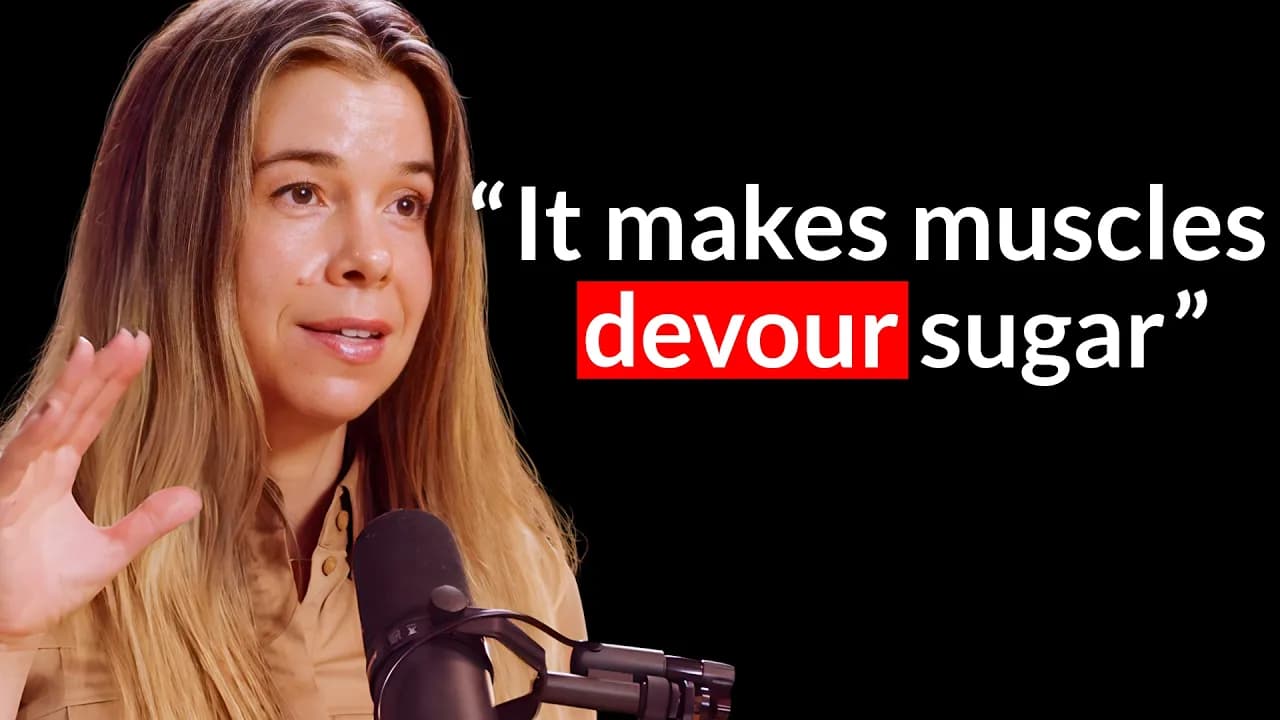
When you work out hard, your muscles use more sugar from your blood for energy. They do this by putting more sugar-carrying gateways (GLUT4) on the outside of the muscle cells, so more sugar can get in.
See the scientific wording
Vigorous exercise-induced muscle contraction stimulates glucose uptake by increasing the number of GLUT4 transporters on the muscle cell surface.
Correlational — new studies may shift this
Observational3 moderate-quality studies link this claim to the outcome, but causation is not established.
What the research says
3 studies reviewedSupporting (2)
Cross-Sectional StudyHuman2015
This study shows that when you exercise, your muscle cells move more sugar doorways (GLUT4) to the outside, so more sugar can get in, which is exactly what the claim says.
Cross-Sectional StudyHuman2025
Even when people take a medicine that blocks a certain immune signal, exercise still helps their muscles take in more sugar by increasing the number of sugar-carrying gates, so the claim is supported.
Contradicting (1)
Cohort StudyAnimal2023
In this study on horses, after exercise the leg muscles had less of the sugar transporter GLUT4, not more, which goes against the idea that exercise puts more sugar gateways on muscle cells.
Quality-weighted scoring: we follow the GRADE framework — each study is rated High, Moderate, Low, or Very Low based on study design, methodology rigor, and risk of bias. A single high-quality RCT can outweigh several weaker observational studies.
Scores reflect study quality, not just count.
When you exercise hard, your muscles tighten and relax quickly. This movement sends signals inside the muscle cells that tell the cells to move special sugar gateways from inside the cell to the outer surface. These gateways are called GLUT4. With more gateways on the surface, sugar from the blood can enter the muscle cells more easily, giving the muscles energy.
Score breakdown, mechanism chain, raw evidence, ideal studies needed & 2 supporting, 1 contradicting studies
How Fit Body Science checks a claim
- 1
We isolate the claim
Health advice from videos, articles and studies is broken down into single, testable claims.
- 2
We find the research
Each claim is matched against peer-reviewed studies, with every source cited by DOI.
- 3
We grade the evidence
Studies are scored on methodology, statistical rigor, transparency and publication quality.
The fitness and health internet is full of confident claims. We check them against real research.
Every claim on this site is traced back to peer-reviewed studies, scored on methodology and reporting quality, and given a verdict you can audit yourself — sources, DOIs and all.
- Full evidence breakdown and mechanism chains
- Ask our AI anything about a claim or its studies
- Get notified when new research changes a verdict
When you work out hard, your muscles use more sugar from your blood for energy. They do this by putting more sugar-carrying gateways (GLUT4) on the outside of the muscle cells, so more sugar can get in.
Mechanism
3 studiesWhen you exercise hard, your muscles contract, which sends signals that move sugar gates to the surface of the muscle cells. These sugar gates let sugar from your blood enter the muscles to give them energy. This happens without needing insulin. The exercise directly causes the gates to move from inside the cell to the outside, so the muscle can take up more sugar.
When you exercise hard, your muscles tighten and relax quickly. This movement sends signals inside the muscle cells that tell the cells to move special sugar gateways from inside the cell to the outer surface. These gateways are called GLUT4. With more gateways on the surface, sugar from the blood can enter the muscle cells more easily, giving the muscles energy.
Muscle contraction during vigorous exercise activates calcium-dependent and AMPK-mediated signaling pathways inside muscle cells.
These signaling pathways trigger the mobilization of GLUT4 storage vesicles from intracellular clusters located near the trans-Golgi network and endosomes.
The GLUT4-containing vesicles fuse with the plasma membrane and T-tubules, dispersing GLUT4 transporters into the membrane.
The increased number of GLUT4 transporters on the plasma membrane enhances facilitated glucose transport into muscle cells, increasing glucose uptake.
Evidence from Studies
Last searched 1mo ago
Supporting (2)
Community contributions welcome
Visualization and quantitation of GLUT4 translocation in human skeletal muscle following glucose ingestion and exercise
This study shows that when you exercise, your muscle cells move more sugar doorways (GLUT4) to the outside, so more sugar can get in, which is exactly what the claim says.
Interleukin-6 Blockade Does Not Impair Exercise-Induced Glucose Uptake and Insulin Sensitivity in Rheumatoid Arthritis.
Even when people take a medicine that blocks a certain immune signal, exercise still helps their muscles take in more sugar by increasing the number of sugar-carrying gates, so the claim is supported.
Contradicting (1)
Community contributions welcome
In this study on horses, after exercise the leg muscles had less of the sugar transporter GLUT4, not more, which goes against the idea that exercise puts more sugar gateways on muscle cells.
Score Breakdown
No multi-axis breakdown available yet. The overall Pro / Against score above is the best signal.
- No clinical evidence is available; the score reflects mechanistic plausibility only.
What Would Prove This
Per GRADE and EBM methodology, here is what ideal scientific evidence would look like to definitively prove or disprove this claim, ordered from strongest to weakest.
Systematic Review and Meta-Analysis of Exercise Interventions on Muscle GLUT4 Expression and Glucose Uptake
Comprehensive search and meta-analysis of randomized controlled trials that compare exercise interventions (including vigorous intensity) to sedentary or moderate exercise controls, with outcomes including muscle GLUT4 protein content and glucose uptake rates. Duration and characteristics of exercise programs would be extracted and analyzed.
Randomized Controlled Trial of High-Intensity Interval Training vs. Moderate Continuous Exercise on Muscle GLUT4 Translocation and Glucose Uptake
Parallel-group RCT with participants randomized to either a vigorous exercise group (e.g., HIIT) or a moderate exercise group, with a non-exercising control group. Outcomes include muscle biopsies for GLUT4 surface expression and glucose disposal rates measured via hyperinsulinemic-euglycemic clamp or stable isotopes, assessed before and after a 12-week intervention.
Prospective Cohort Study of Physical Activity Levels and Muscle GLUT4 Expression in Healthy Adults
Prospective observational study following a cohort of adults with varying levels of physical activity (e.g., athletes vs. sedentary individuals) over several years. Baseline and follow-up muscle biopsies would measure GLUT4 protein and mRNA, along with periodic glucose tolerance tests. Analyses would adjust for confounders like age, sex, BMI, and diet.
Cross-Sectional Comparison of Muscle GLUT4 Content in Endurance-Trained Athletes vs. Sedentary Controls
Observational study comparing a group of endurance-trained athletes (e.g., cyclists, runners) who perform vigorous exercise regularly with a matched sedentary control group. Muscle biopsies are taken to measure GLUT4 protein and glucose uptake capacity, with appropriate matching for age, sex, and body composition.
In Vitro Study of Electrically Stimulated Myotubes on GLUT4 Translocation and Glucose Uptake
Cultured myotubes (e.g., C2C12 cells) are subjected to electrical pulse stimulation to mimic muscle contraction. Outcome measures include GLUT4 translocation to the plasma membrane (e.g., via fluorescent labeling or cell-surface biotinylation) and glucose uptake assays (e.g., 2-deoxyglucose uptake). Experimental groups include stimulated vs. non-stimulated myotubes, with and without inhibitors of contraction-related pathways.