Sitting for a long time makes your muscles not work, so your body releases more insulin to control your blood sugar.
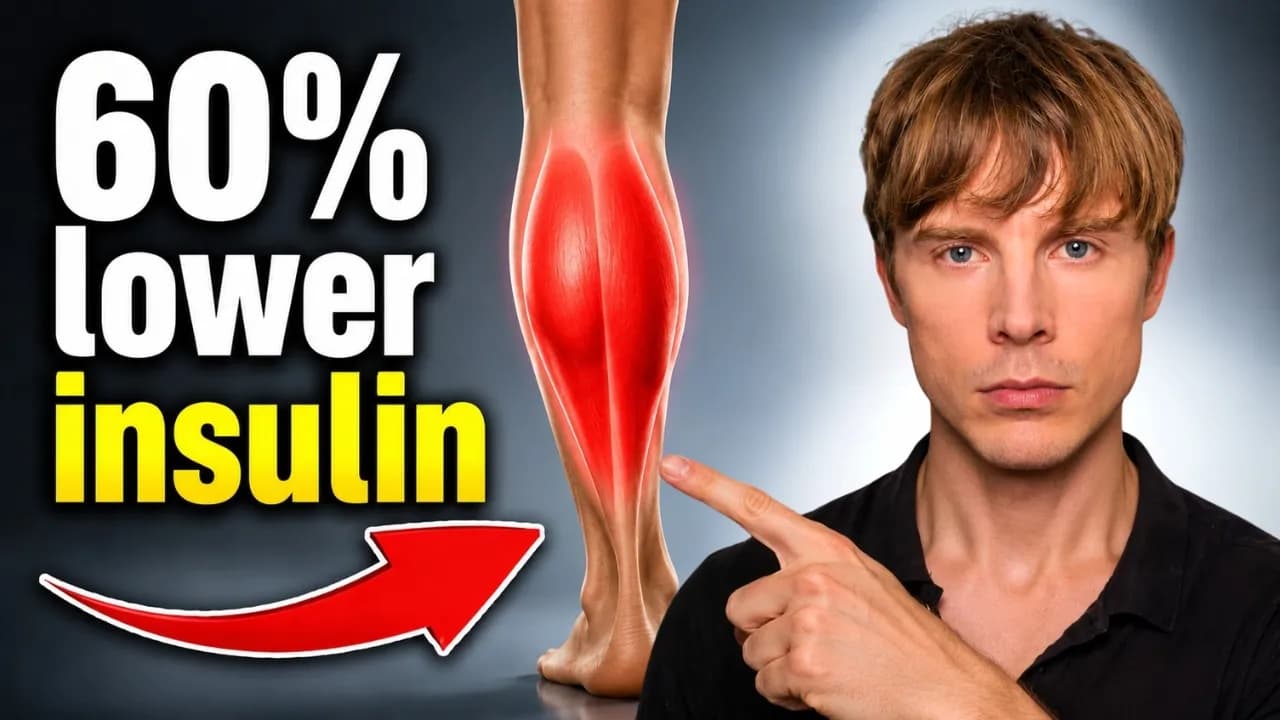 From Your Second Heart Is Destroying Your Metabolism · video
See the scientific wording
Prolonged sitting causes skeletal muscle inactivity, which leads to increased insulin secretion to manage blood glucose levels.
There's disagreement
Randomized trialsThe 3 studies we reviewed point in different directions — there's no clear consensus.
What the research says
3 studies reviewedSupporting (2)
Adipose Tissue Responses to Breaking Sitting in Men and Women with Central Adiposity
Randomized Controlled TrialHuman2018
Sitting for a long time makes your body produce more insulin after meals, and taking short walks regularly lowers both blood sugar and insulin levels.
Randomized Controlled TrialHuman2025
This study shows that if you sit for a long time, your body becomes less sensitive to insulin, so your pancreas would have to make more insulin to keep your blood sugar normal. Taking short activity breaks helps your body use insulin better, so you need less insulin.
Contradicting (1)
Randomized Controlled TrialHuman2019
The study found that taking breaks from sitting doesn't change your blood sugar, so it's unlikely that sitting makes your body need more insulin.
Quality-weighted scoring: we follow the GRADE framework — each study is rated High, Moderate, Low, or Very Low based on study design, methodology rigor, and risk of bias. A single high-quality RCT can outweigh several weaker observational studies.
Scores reflect study quality, not just count.
If you sit still for a long time, your leg muscles don't move. When muscles don't move, they don't take sugar from your blood as well. So after eating, sugar stays in your blood longer. To deal with this, your body makes more insulin, which helps push sugar into cells. So your body has to release extra insulin to keep your blood sugar under control.
Score breakdown, mechanism chain, raw evidence, ideal studies needed & 2 supporting, 1 contradicting studies
How Fit Body Science checks a claim
- 1
We isolate the claim
Health advice from videos, articles and studies is broken down into single, testable claims.
- 2
We find the research
Each claim is matched against peer-reviewed studies, with every source cited by DOI.
- 3
We grade the evidence
Studies are scored on methodology, statistical rigor, transparency and publication quality.
The fitness and health internet is full of confident claims. We check them against real research.
Every claim on this site is traced back to peer-reviewed studies, scored on methodology and reporting quality, and given a verdict you can audit yourself — sources, DOIs and all.
- Full evidence breakdown and mechanism chains
- Ask our AI anything about a claim or its studies
- Get notified when new research changes a verdict
Sitting for a long time makes your muscles not work, so your body releases more insulin to control your blood sugar.
Mechanism
4 studiesSitting without moving makes your muscles less able to soak up sugar from your blood. That causes sugar to build up, so your body makes extra insulin to help push the sugar into cells. This extra insulin is your body's way of managing the higher blood sugar.
If you sit still for a long time, your leg muscles don't move. When muscles don't move, they don't take sugar from your blood as well. So after eating, sugar stays in your blood longer. To deal with this, your body makes more insulin, which helps push sugar into cells. So your body has to release extra insulin to keep your blood sugar under control.
Prolonged sitting minimizes skeletal muscle contraction, reducing energy expenditure and the need for glucose uptake.
Reduced muscle contraction lowers the translocation of GLUT4 to the muscle cell membrane, reducing insulin-independent glucose uptake.
Diminished muscle glucose disposal leads to higher postprandial blood glucose concentrations.
Elevated blood glucose triggers increased insulin secretion from pancreatic beta cells to enhance glucose clearance from the blood.
Evidence from Studies
Last searched 1mo ago
Supporting (2)
Community contributions welcome
Adipose Tissue Responses to Breaking Sitting in Men and Women with Central Adiposity
Sitting for a long time makes your body produce more insulin after meals, and taking short walks regularly lowers both blood sugar and insulin levels.
This study shows that if you sit for a long time, your body becomes less sensitive to insulin, so your pancreas would have to make more insulin to keep your blood sugar normal. Taking short activity breaks helps your body use insulin better, so you need less insulin.
Contradicting (1)
Community contributions welcome
The effect of frequency of activity interruptions in prolonged sitting on postprandial glucose metabolism: A randomized crossover trial.
The study found that taking breaks from sitting doesn't change your blood sugar, so it's unlikely that sitting makes your body need more insulin.
Score Breakdown
No multi-axis breakdown available yet. The overall Pro / Against score above is the best signal.
- No clinical evidence is available; the score reflects mechanistic plausibility only.
What Would Prove This
Per GRADE and EBM methodology, here is what ideal scientific evidence would look like to definitively prove or disprove this claim, ordered from strongest to weakest.
Systematic Review and Meta-Analysis of Randomized Controlled Trials Comparing Prolonged Sitting vs. Active Breaks on Insulin Secretion
A systematic search of RCTs that randomized participants to either prolonged sitting (e.g., 8 hours/day) or interrupted sitting with periodic standing or walking breaks, measuring insulin secretion via hyperglycemic clamp or glucose tolerance tests, and pooling results in meta-analysis.
Randomized Controlled Trial of Prolonged Sitting vs. Regular Movement Breaks on Pancreatic Insulin Secretion
Randomized crossover trial where healthy adults undergo two conditions: (a) prolonged sitting for 8 hours and (b) sitting with 3-minute light walking breaks every 30 minutes, with insulin and glucose levels measured at regular intervals.
Prospective Cohort Study of Occupational Sitting Time and Incident Hyperinsulinemia
Longitudinal study following a large cohort of adults for 5-10 years, collecting self-reported or objective sitting time at baseline and periodically, and measuring fasting insulin and glucose to assess insulin secretion and resistance.
Case-Control Study Comparing Insulin Secretion in Adults with High vs. Low Sedentary Time
Select cases with hyperinsulinemia (high insulin levels) and controls with normal insulin, then retrospectively measure their sitting time via questionnaire or accelerometry, and compare.
Cross-Sectional Association Between Daily Sitting Time and Fasting Insulin Levels in Adults
In a sample of adults, measure sitting time via accelerometer and take fasting blood samples for insulin; analyze correlation.