Eating trans fats leads to more fat accumulating around internal organs, even if the total number of calories consumed stays the same.
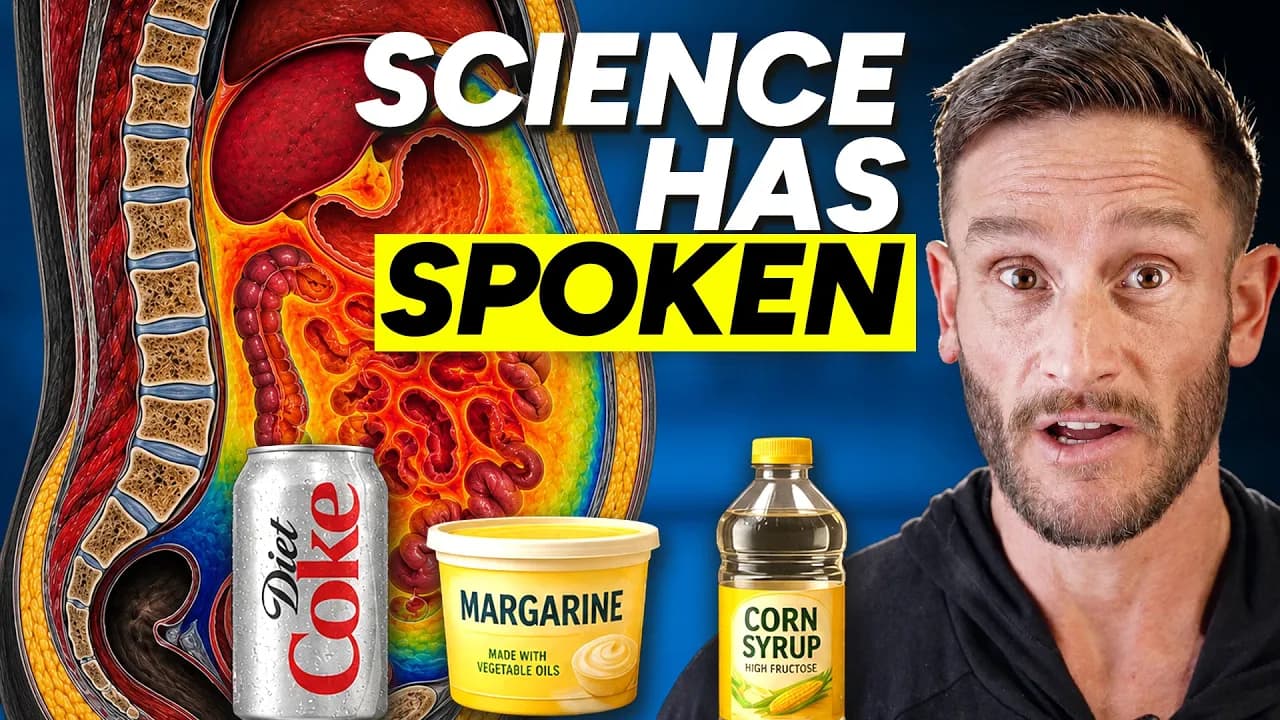 From These Foods Store Immediately as Visceral Fat · video
See the scientific wording
Consumption of trans fats increases the accumulation of visceral fat in humans, regardless of total caloric intake.
There's disagreement
ObservationalThe 2 studies we reviewed point in different directions — there's no clear consensus.
What the research says
2 studies reviewedSupporting (1)
Cross-Sectional StudyHuman2005
Even though this study didn’t make people eat more trans fats, it found that people who already ate them had more of these fats stored around their internal organs compared to other fat areas — suggesting trans fats specifically build up where they’re most harmful.
Contradicting (1)
Cohort StudyHuman2025
This study found that eating trans fats made more fat build up in the liver and less around the organs, which is the opposite of what the claim says. So, trans fats didn’t make belly fat go up—they made it go down.
Quality-weighted scoring: we follow the GRADE framework — each study is rated High, Moderate, Low, or Very Low based on study design, methodology rigor, and risk of bias. A single high-quality RCT can outweigh several weaker observational studies.
Scores reflect study quality, not just count.
Trans fats get absorbed and change how the body stores fat, causing more fat to collect around internal organs instead of being stored elsewhere or burned. This happens because trans fats make fat cells around the organs take up more fat and also reduce the liver’s ability to store fat, forcing more fat into the belly area.
Score breakdown, mechanism chain, raw evidence, ideal studies needed & 1 supporting, 1 contradicting studies
Related videos
How Fit Body Science checks a claim
- 1
We isolate the claim
Health advice from videos, articles and studies is broken down into single, testable claims.
- 2
We find the research
Each claim is matched against peer-reviewed studies, with every source cited by DOI.
- 3
We grade the evidence
Studies are scored on methodology, statistical rigor, transparency and publication quality.
The fitness and health internet is full of confident claims. We check them against real research.
Every claim on this site is traced back to peer-reviewed studies, scored on methodology and reporting quality, and given a verdict you can audit yourself — sources, DOIs and all.
- Full evidence breakdown and mechanism chains
- Ask our AI anything about a claim or its studies
- Get notified when new research changes a verdict
Eating trans fats leads to more fat accumulating around internal organs, even if the total number of calories consumed stays the same.
Mechanism
3 studiesTrans fats change how the body moves and stores fat, making more fat collect around the organs instead of in other areas. This happens because the liver stores more fat internally, leaving more fat in the blood for the belly area to absorb, even when total calories stay the same.
Trans fats get absorbed and change how the body stores fat, causing more fat to collect around internal organs instead of being stored elsewhere or burned. This happens because trans fats make fat cells around the organs take up more fat and also reduce the liver’s ability to store fat, forcing more fat into the belly area.
Trans fatty acids are absorbed from the diet and incorporated into circulating lipoproteins, increasing their delivery to visceral adipose tissue.
Visceral adipocytes exhibit increased expression of lipid uptake transporters and enhanced lipoprotein lipase activity, promoting selective triglyceride storage in visceral depots.
Hepatic metabolism of trans fatty acids upregulates GPAM, increasing triglyceride synthesis and sequestration in the liver, which reduces systemic lipid availability and redirects lipid flux toward visceral adipose tissue.
Reduced hepatic lipid export and altered adipokine signaling create a metabolic environment that favors lipid retention in visceral adipose tissue over subcutaneous depots.
Evidence from Studies
Last searched 3mo ago
Supporting (1)
Community contributions welcome
Even though this study didn’t make people eat more trans fats, it found that people who already ate them had more of these fats stored around their internal organs compared to other fat areas — suggesting trans fats specifically build up where they’re most harmful.
Contradicting (1)
Community contributions welcome
GPAM upregulation enhances hepatic fat deposition and reduces visceral adipose tissue in response to trans-fatty acids
This study found that eating trans fats made more fat build up in the liver and less around the organs, which is the opposite of what the claim says. So, trans fats didn’t make belly fat go up—they made it go down.
Score Breakdown
No multi-axis breakdown available yet. The overall Pro / Against score above is the best signal.
- No clinical evidence is available; the score reflects mechanistic plausibility only.
What Would Prove This
Per GRADE and EBM methodology, here is what ideal scientific evidence would look like to definitively prove or disprove this claim, ordered from strongest to weakest.
Systematic Review of Controlled Feeding Trials on Trans Fat Intake and Visceral Fat Accumulation
Population: Healthy adults aged 25–65; Intervention: High trans fat diet (≥2% of total energy); Comparator: Isocaloric diet with no trans fats; Outcome: Visceral fat mass measured by DEXA or MRI; Duration: 8–12 weeks.
Double-Blind, Isocaloric Trial Comparing Trans Fat vs. Unsaturated Fat on Visceral Fat Accumulation
Population: 100 healthy adults with normal BMI; Intervention: 10% of daily calories from trans fats; Comparator: 10% of daily calories from monounsaturated fats; Outcome: Change in visceral adipose tissue via CT scan; Duration: 12 weeks; Control: Double-blind, randomized, crossover design.
Prospective Cohort Study of Trans Fat Intake and Visceral Fat Accumulation Over 5 Years
Population: 5,000 adults aged 30–70; Intervention: Dietary trans fat intake assessed via food frequency questionnaires; Comparator: Low vs. high trans fat consumers; Outcome: Visceral fat measured by MRI at baseline and 5-year follow-up; Duration: 5 years.
Case-Control Study of High Visceral Fat vs. Normal Visceral Fat Individuals and Historical Trans Fat Intake
Population: 200 cases with high visceral fat (MRI-defined) and 200 matched controls; Intervention: Retrospective dietary recall of trans fat intake over prior 5 years; Comparator: Trans fat intake levels between cases and controls; Outcome: Odds ratio of high trans fat intake in cases vs. controls; Duration: Retrospective analysis.
Cross-Sectional Analysis of Trans Fat Intake and Visceral Fat in a Population Survey
Population: 1,000 adults from a national health survey; Intervention: Self-reported trans fat intake; Comparator: High vs. low trans fat consumers; Outcome: Visceral fat measured by bioimpedance or waist-to-hip ratio; Duration: Single time point.