House of Hypertrophy
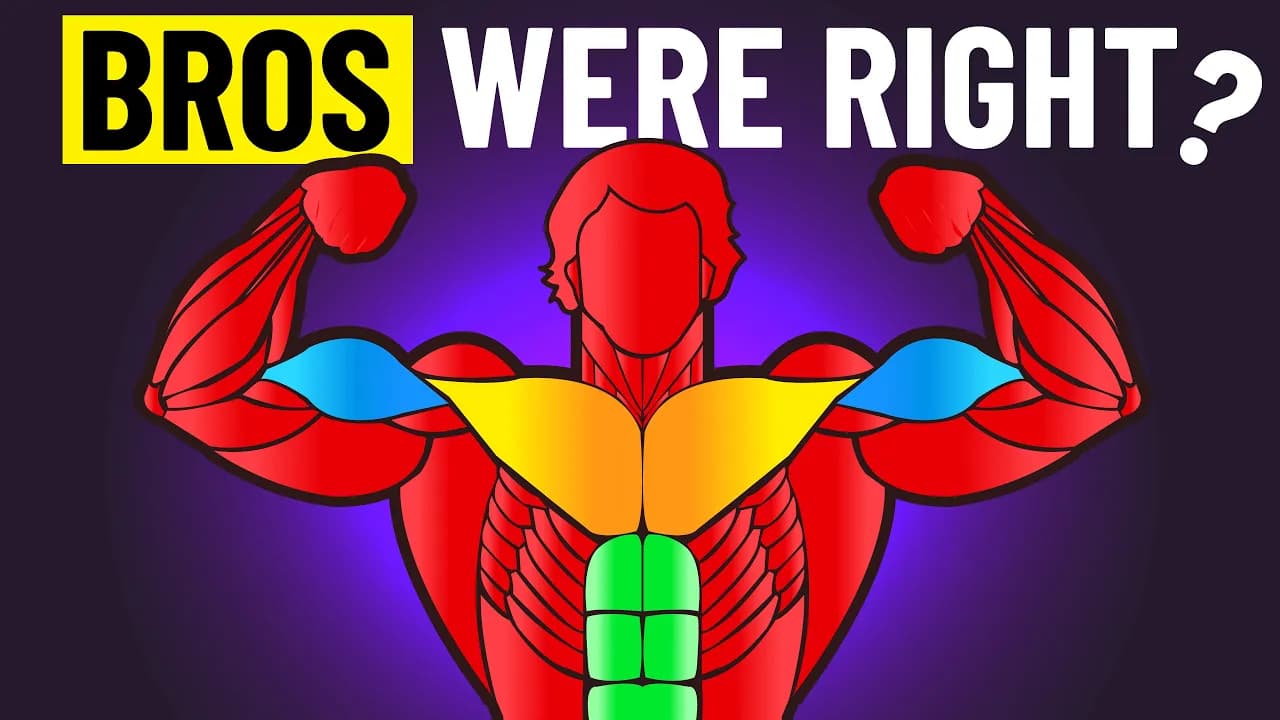
Cheat reps build muscle as well as strict reps in beginners, but strength gains are harder to interpret and long-term safety is unknown.
Cheat reps and strict reps produce similar muscle growth in beginners, but cheat reps make strength progress harder to measure and injury risk remains unassessed.
We checked the science
our breakdown of the video
10 claims, each mapped to its moment in the video
Performing strength exercises until muscle fatigue, with 8 to 12 repetitions per set, results in an increase in muscle size in people who have not previously trained regularly.
Multiple causal studies (randomized trials and reviews) support this claim.
Training one limb with resistance exercises can result in increased strength in the opposite, untrained limb.
Multiple causal studies (randomized trials and reviews) support this claim.
When lifting weights until complete fatigue, using momentum from body movement does not lessen muscle growth in the targeted muscles.
Multiple causal studies (randomized trials and reviews) support this claim.
Changing how you perform resistance exercises, such as squats or bench presses, changes the amount of mechanical stress applied to the muscles being worked.
Strong evidence from clinical studies backs this claim.
People who have not previously trained may experience different muscle growth patterns from those who have been training regularly, when exposed to the same exercise routines.
Multiple causal studies (randomized trials and reviews) support this claim.
People who have not previously trained respond with varying amounts of muscle growth depending on the type of resistance training they perform.
Evidence contradicts this claim.
Current research does not directly show that using momentum while lifting weights leads to a higher chance of injury.
Multiple causal studies (randomized trials and reviews) support this claim.
Using momentum to lift weights during resistance training lets people lift heavier weights, but the heavier weights do not necessarily mean the muscles have become stronger.
Multiple causal studies (randomized trials and reviews) support this claim.
When performing biceps curls with relaxed form (cheating), the biceps muscle experiences higher mechanical tension when stretched to longer lengths than when performing the same movement with strict form and controlled speed.
Not enough evidence yet — take this with caution.
When the total mechanical workload is the same, training muscles while they are stretched does not consistently lead to more muscle growth than training them while they are shortened.
Multiple causal studies (randomized trials and reviews) support this claim.
Key Takeaways
Summary
Based on the video transcript only.
- 1Problem: People wonder if swinging weights during curls and pushdowns (cheating) makes muscles grow less than lifting slowly and perfectly (strict).
- 2Core methods: Cheat reps using external momentum during dumbbell curls and pushdowns; strict reps with no body movement and only elbow motion.
- 3How methods work: Cheat reps use body swing and leg drive to lift heavier weights; strict reps keep the body still and move only the elbow joint to isolate the muscle.
- 4Expected outcomes: Both methods led to the same amount of muscle growth in the biceps, brachialis, and triceps after 8 weeks.
- 5Implementation timeframe: Results were seen after 8 weeks of training twice per week.
Related videos

House of Hypertrophy
Unilateral vs Bilateral Training for Muscle Growth
House of Hypertrophy
More Sets, More Growth: This NEW Study is Surprising (& Epic)
House of Hypertrophy
How Many Reps for Muscle Growth? (40+ Studies)
House of Hypertrophy
Is Overtraining Easier Than We Think?
House of Hypertrophy
“Compound Exercises Are Enough for the Biceps” (New Study)
House of Hypertrophy