Jeremy Ethier
Belly fat layer model lacks scientific support as all claims have zero evidence scores
All video claims lack supporting evidence with pro and against scores at zero.
We checked the science
our breakdown of the video
12 claims, each mapped to its moment in the video
DEXA scans can show how much fat is in different parts of your body, like arms, legs, and belly, not just the total.
Not enough evidence yet — take this with caution.
Men usually have more belly fat than other parts of their body.
Evidence points in both directions — no clear conclusion yet.
Gaining a few centimeters around your waist makes you more likely to get sick or die, even if your total weight doesn't change.
Evidence contradicts this claim.
When men have more than 25% body fat, their belly stores fat more easily and is harder to lose than other areas.
Not enough evidence yet — take this with caution.
When you're very fat, your arms and legs lose fat faster than your belly, but once you get leaner, your belly starts losing fat faster too.
Not enough evidence yet — take this with caution.
Women usually store more fat in their hips and legs than in their belly.
Not enough evidence yet — take this with caution.
Men need to be at 20% body fat to see abs, while women need to be at 28% to see a tighter waist.
Not enough evidence yet — take this with caution.
Some people's bodies burn calories faster when dieting, while others slow down their metabolism to conserve energy.
Not enough evidence yet — take this with caution.
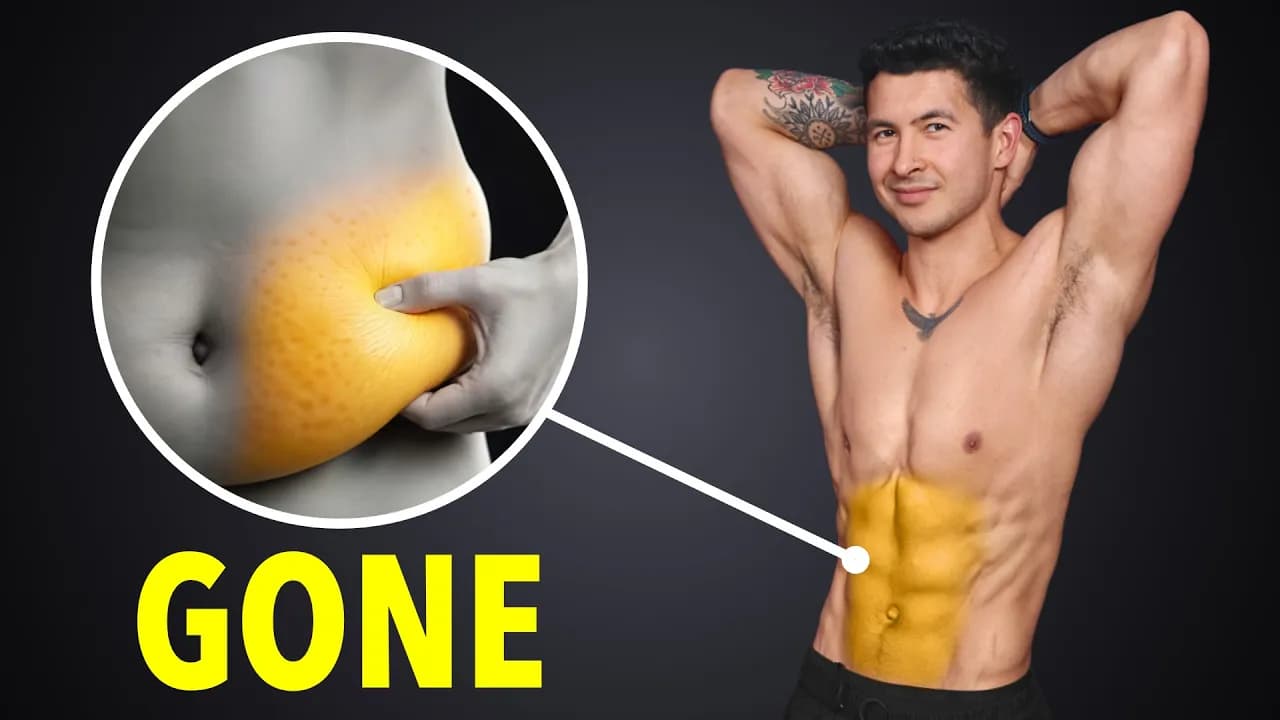
Belly fat has three layers, and the third layer is the hardest to lose, with very few people able to get rid of it completely.
Not enough evidence yet — take this with caution.
Some fat has receptors that make it easy to burn, while stubborn fat has receptors that slow down burning, especially in the lower belly and hips.
Not enough evidence yet — take this with caution.
Stress hormones make your body hold water, making your belly look bloated even if you're losing fat.
Not enough evidence yet — take this with caution.
Taking a short break from dieting by eating more calories can help reduce stress hormones and hunger, making it easier to continue losing fat.
Not enough evidence yet — take this with caution.
Key Takeaways
Summary
Based on the video transcript only.
- 1Problem: Belly fat is harder to lose than other areas because your body stores more fat there initially, especially at higher body fat levels.
- 2Core methods: Layer 1 (3 workouts/week, protein at every meal, 8,000 steps), Layer 2 (10,000 steps, 4-day strength training, calorie tracking), Layer 3 (diet breaks, swapping rice for potatoes, managing stress).
- 3How methods work: Layer 1 burns easy fat first; Layer 2 adjusts for slower metabolism; Layer 3 uses breaks and smart food swaps to tackle stubborn fat.
- 4Expected outcomes: Visible abs, lower body fat percentage, and muscle gain while losing fat.
- 5Implementation timeframe: Layer 1 takes ~90 days, Layer 2 takes 10-16 weeks, Layer 3 varies; total journey took 275 days including maintenance breaks.