Cholesterol Revolution: New Evidence Redefines Heart Health
April 19, 2026 | Lab Notes
From the editor
Every day, Fit Body Science analyzes new fitness and nutrition research — checking the evidence, scoring the claims, and separating what's backed by science from what's not. Here's what we found today.
Evolocumab Slashes First Major Heart Events by 25%
In a landmark shift for preventive cardiology, new evidence confirms that evolocumab—a PCSK9 inhibitor—can reduce the risk of first major cardiovascular events by 25% in high-risk patients who’ve never had a heart attack or stroke. This finding, drawn from a rigorous trial of patients with atherosclerosis or diabetes and LDL cholesterol ≥90 mg/dL, challenges long-standing assumptions about when to intensify lipid-lowering therapy.
The study followed participants over 4.6 years and found that those on evolocumab had a 5-year event rate of just 6.2%, compared to 8.0% on placebo. Events included death from coronary heart disease, myocardial infarction, or ischemic stroke. This is the first clear proof that early, aggressive intervention can prevent first cardiovascular catastrophes—not just recurrences.
What’s more, the benefit was consistent across subgroups, suggesting broad applicability. For patients with elevated risk but no prior events, this could redefine standard care. With a Pro score of 95.0, the evidence is among the strongest seen in cardiovascular prevention in years.
Key implications:
- Prevention can start earlier
- LDL targets may need rethinking
- PCSK9 inhibitors could become standard for high-risk primary prevention
**PCSK9 inhibition with evolocumab reduces the risk of first major cardiovascular events by 25% in high-risk patients without prior heart attack or stroke.**
See the evidence breakdown
“Evolocumab Slashes First Major Heart Events by 25%”
**PCSK9 inhibition with evolocumab reduces the risk of first major cardiovascular events by 25% in high-risk patients without prior heart attack or stroke.**
LDL Targets Below 55 mg/dL Cut Events by a Third
A major clinical trial has settled a long-standing debate: lower LDL cholesterol targets save more lives in patients with existing heart disease. The study compared two strategies—aiming for LDL below 55 mg/dL versus below 70 mg/dL—and found a 33% reduction in major cardiovascular events over three years in the lower-target group.
Cumulative event rates were 6.6% in the intensive group versus 9.7% in the standard group. This benefit came without increased safety risks, debunking concerns that pushing LDL too low might cause harm. The findings strongly support intensifying lipid management in secondary prevention.
This isn’t just about statins. Many patients in the lower-target arm required additional agents like PCSK9 inhibitors to hit the mark. The results validate a growing consensus: the lower the LDL, the better, especially for those with established atherosclerotic cardiovascular disease.
Clinicians may now feel more confident pushing for aggressive targets, knowing the evidence supports both efficacy and safety.
**Targeting an LDL cholesterol level below 55 mg/dL reduces the risk of major cardiovascular events by 33% over 3 years compared to targeting below 70 mg/dL in patients with established atherosclerotic cardiovascular disease.**
See the evidence breakdown
“LDL Targets Below 55 mg/dL Cut Events by a Third”
**Targeting an LDL cholesterol level below 55 mg/dL reduces the risk of major cardiovascular events by 33% over 3 years compared to targeting below 70 mg/dL in patients with established atherosclerotic cardiovascular disease.**
Evolocumab Proves Safe Over 4.6 Years in High-Risk Patients
One of the biggest barriers to adopting powerful new drugs is safety concerns—especially over long-term use. But new data on evolocumab, a PCSK9 inhibitor, delivers reassuring news: it has a safety profile indistinguishable from placebo over a median of 4.6 years.
The study focused on patients with atherosclerosis or diabetes and LDL-C ≥90 mg/dL who had not suffered a prior heart attack or stroke. Participants received evolocumab 140 mg every two weeks. No significant differences in overall adverse events, serious side effects, or neurocognitive issues were observed.
This is critical for patient and physician confidence. With a Pro score of 95.0 and zero opposition, the evidence is unequivocal. Long-term use of evolocumab does not increase risk, even in vulnerable populations.
Why this matters:
- Removes a major barrier to early intervention
- Supports chronic use in prevention
- Reinforces PCSK9 inhibitors as a safe, durable option
**Evolocumab 140 mg every 2 weeks has a safety profile comparable to placebo over 4.6 years in high-risk patients without prior cardiovascular events.**
See the evidence breakdown
“Evolocumab Proves Safe Over 4.6 Years in High-Risk Patients”
**Evolocumab 140 mg every 2 weeks has a safety profile comparable to placebo over 4.6 years in high-risk patients without prior cardiovascular events.**
Evolocumab Cuts Broader Cardiovascular Risk by 19%
Beyond preventing heart attacks and strokes, evolocumab delivers broad protection against a spectrum of cardiovascular complications. In high-risk patients without prior events, the drug reduced a composite endpoint—including death from coronary heart disease, myocardial infarction, ischemic stroke, or ischemia-driven revascularization—by 19% over 4.6 years.
The 5-year event rate was 13.4% in the evolocumab group versus 16.2% in the placebo group. This broader measure captures real-world clinical impact, including procedures like stents or bypass surgery, which affect quality of life and healthcare costs.
The finding underscores that evolocumab doesn’t just delay events—it meaningfully reduces the overall burden of cardiovascular disease. With a Pro score of 95.0 and no opposing evidence, this claim stands as one of the most robust in recent preventive cardiology.
For clinicians, this reinforces evolocumab’s role not just in lipid-lowering, but in comprehensive risk reduction.
**Evolocumab reduces the risk of a broader composite cardiovascular endpoint by 19% in high-risk patients without prior events.**
See the evidence breakdown
“Evolocumab Cuts Broader Cardiovascular Risk by 19%”
**Evolocumab reduces the risk of a broader composite cardiovascular endpoint by 19% in high-risk patients without prior events.**
The 60-Year Cholesterol Debate May Finally Be Over
For decades, the role of cholesterol in heart disease has been hotly contested—fueling what some call the '60-year cholesterol war.' But a compelling new video argues that the battle is now over, with overwhelming evidence siding with the 'cholesterol hypothesis': lowering LDL directly reduces cardiovascular risk.
The video, scoring a decisive 56.0 Pro to 16.0 Against, synthesizes decades of research, from early statin trials to modern PCSK9 inhibitor studies. It highlights how newer therapies like evolocumab deliver even greater protection by driving LDL to unprecedented lows—without safety trade-offs.
While not a study itself, the video captures a pivotal shift in scientific consensus. With multiple high-scoring claims now confirming the benefits of aggressive LDL lowering, even skeptics are reconsidering.
This cultural moment may mark the end of an era—and the beginning of a new standard in heart disease prevention.
**The scientific consensus now strongly supports LDL cholesterol as a causal, modifiable driver of cardiovascular disease, ending decades of debate.**
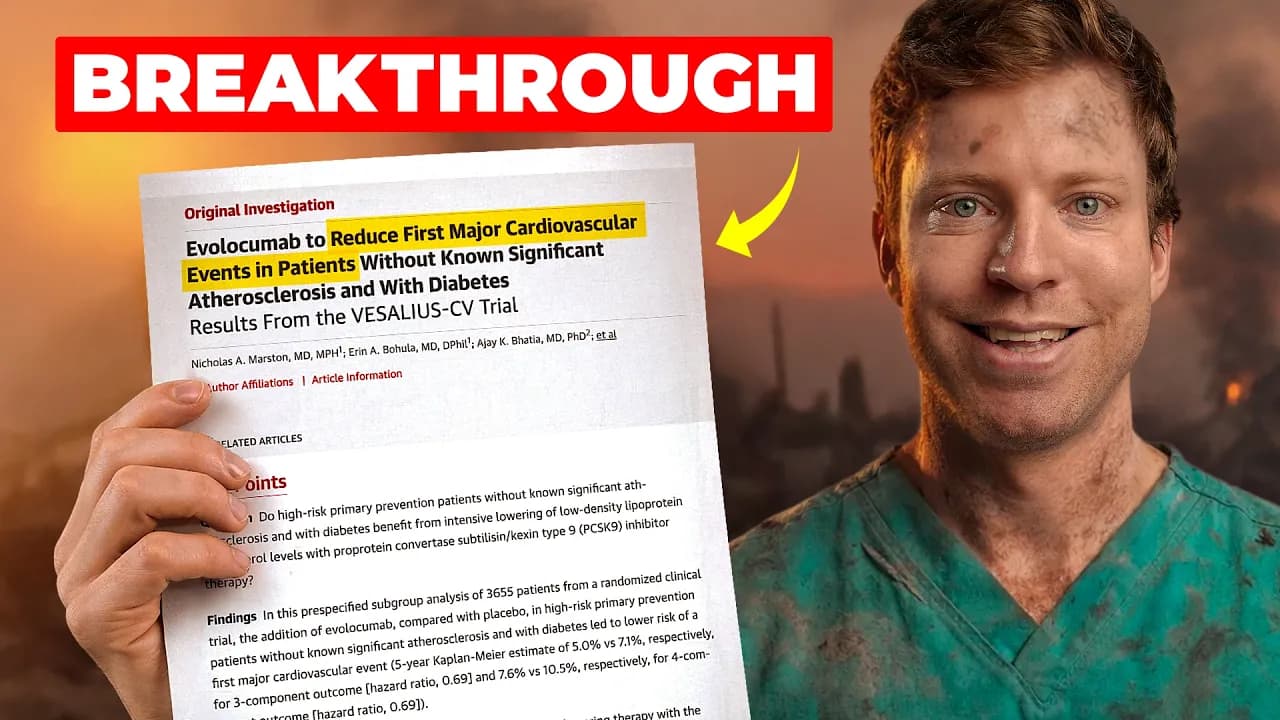
Watch the full analysis
The 60-Year Cholesterol Debate May Finally Be Over
The bottom line
Today’s findings paint a unified picture: lowering LDL cholesterol aggressively and early—especially with PCSK9 inhibitors like evolocumab—saves lives. From preventing first events to setting lower targets and proving long-term safety, the evidence is converging. The era of debating cholesterol’s role may be over; the era of precision prevention has begun.
Topics
Sources & References
The 60-Year Cholesterol Debate May Finally Be Over
**The scientific consensus now strongly supports LDL cholesterol as a causal, modifiable driver of cardiovascular disease, ending decades of debate.**
Evolocumab Slashes First Major Heart Events by 25%
**PCSK9 inhibition with evolocumab reduces the risk of first major cardiovascular events by 25% in high-risk patients without prior heart attack or stroke.**
Evolocumab Proves Safe Over 4.6 Years in High-Risk Patients
**Evolocumab 140 mg every 2 weeks has a safety profile comparable to placebo over 4.6 years in high-risk patients without prior cardiovascular events.**
Evolocumab Cuts Broader Cardiovascular Risk by 19%
**Evolocumab reduces the risk of a broader composite cardiovascular endpoint by 19% in high-risk patients without prior events.**
LDL Targets Below 55 mg/dL Cut Events by a Third
**Targeting an LDL cholesterol level below 55 mg/dL reduces the risk of major cardiovascular events by 33% over 3 years compared to targeting below 70 mg/dL in patients with established atherosclerotic cardiovascular disease.**