Thomas DeLauer
Some metabolic claims are supported by human trials, while others rely on small or preliminary studies with limited validation.
Evidence for the protocol's core claims is mixed, with strong support for protein leverage and energy flux, but weak or absent evidence for cortisol rhythm disruption and olive oil's fasting-mimicking effects.
We checked the science
our breakdown of the video
10 claims, each mapped to its moment in the video
People who fast every morning over a long period show a less pronounced daily rhythm in cortisol levels and are more likely to have insulin resistance and metabolic issues.
Shows a real connection between these things — genuine evidence, though it can't prove cause and effect, and stronger studies could still change it.
Eating protein and carbohydrates can lead to lower levels of the stress hormone cortisol by influencing the hypothalamic-pituitary-adrenal axis.
Multiple causal studies (randomized trials and reviews) support this claim.
Going without food for 24 hours can increase the daily fluctuation of cortisol levels, and doing this every day may change how the body's stress response system functions over time.
Good evidence supports this claim, with little to contradict it.
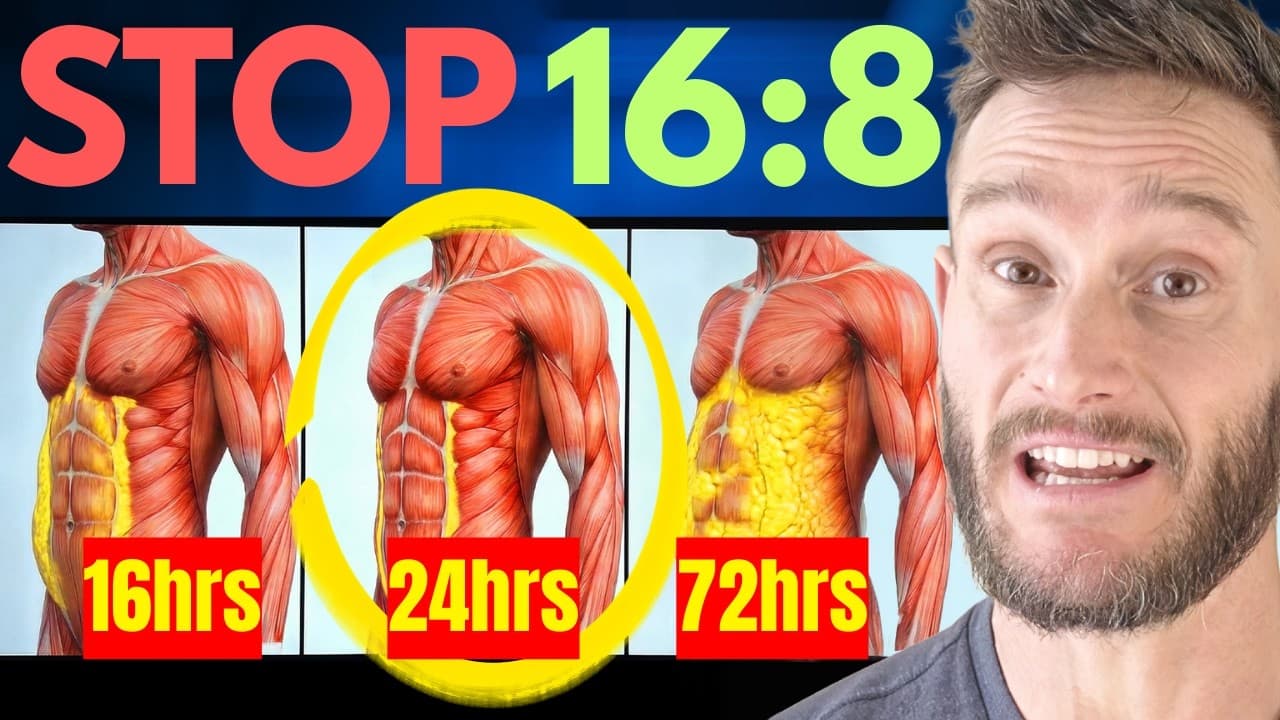
Alternating between three to four longer fasting periods per week, totaling 80–90 hours, provides the same overall fasting time as fasting 16 hours every day, while potentially reducing the frequency of physiological stress responses.
Not enough evidence yet — take this with caution.
When two people consume the same net calorie deficit, their resting metabolic rates and hormone levels may differ depending on how much total energy they are expending through activity and metabolism.
Multiple causal studies (randomized trials and reviews) support this claim.
When the body processes a large amount of energy from food and physical activity, it burns more calories at rest, breaks down more fat, and reduces feelings of hunger, regardless of whether total calorie intake exceeds or falls short of expenditure.
Multiple causal studies (randomized trials and reviews) support this claim.
Human eating behavior is controlled by a set daily amount of protein needed, and feelings of hunger continue until that protein amount is consumed, even if enough calories have been eaten.
Multiple causal studies (randomized trials and reviews) support this claim.
When people reduce the amount of protein in their diet to 10% of their total calories, they tend to eat more total calories without trying.
Multiple causal studies (randomized trials and reviews) support this claim.
Diets eaten by humans before industrialization provided more protein for each calorie consumed than the diets commonly eaten today.
Weak evidence — fewer than 20 studies, so treat this as a starting point, not a fact.
A compound found in olive oil, called oleuropein aglycone, triggers a cellular cleanup process known as autophagy by influencing the AMPK and mTOR signaling molecules.
Weak evidence — fewer than 20 studies, so treat this as a starting point, not a fact.
Key Takeaways
Summary
Based on the video transcript only.
- 1Problem: Doing 16:8 fasting every day keeps your stress hormone (cortisol) high in the morning, which can mess up your metabolism and make it harder to lose fat over time.
- 2Core methods: Do 3–4 longer fasts per week (18–22 hours), eat breakfast on other days, eat lots of protein at your first meal, train hard on eating days, and take 1 tablespoon of olive oil on fasting days.
- 3How methods work: Longer fasts trigger deeper fat-burning and cell cleanup (autophagy); eating breakfast lowers stress hormones; eating lots of protein early stops you from overeating; exercising and eating more on feeding days boosts your metabolism; olive oil has a compound that tricks your body into thinking it’s fasting.
- 4Expected outcomes: You lose fat sustainably, feel less hungry, have more energy, avoid metabolic slowdown, and protect your hormones.
- 5Implementation timeframe: You’ll start noticing less hunger and better energy within 1–2 weeks; hormonal and metabolic improvements build over 4–6 weeks.
Related videos

Thomas DeLauer
You’ll Never Get Hungry During a Fast Again (16 Hours or More)
Thomas DeLauer
The Literal Best Source of Protein for Losing Fat and Building Muscle (hands down)

Thomas DeLauer
This Makes Sedentary People Lose Belly Fat (without exercise)

Thomas DeLauer
They Were Wrong About Fasting (this study misled us)
Thomas DeLauer
They Tried to Ban NAC… (because it works)
Thomas DeLauer