Uncited study references: The creator repeatedly references 'data,' 'studies,' and 'clinical practice' without naming specific studies, journals, authors, or years. Examples include: 'the data is obvious,' 'we know this with very clear clinical practice,' 'the data says X,' and 'studies get rigged.' No verifiable citation of a single study is provided.
Thomas DeLauer
Insulin's role in fat metabolism is supported, but the 36-hour weekly fast has no direct research backing.
While insulin's biological effects on fat breakdown are well-documented, the specific 36-hour fasting protocol has no supporting studies.
We checked the science
our breakdown of the video
10 claims, each mapped to its moment in the video
High insulin levels reduce the breakdown of fat by decreasing the activity of hormone-sensitive lipase.
Strong evidence from clinical studies backs this claim.
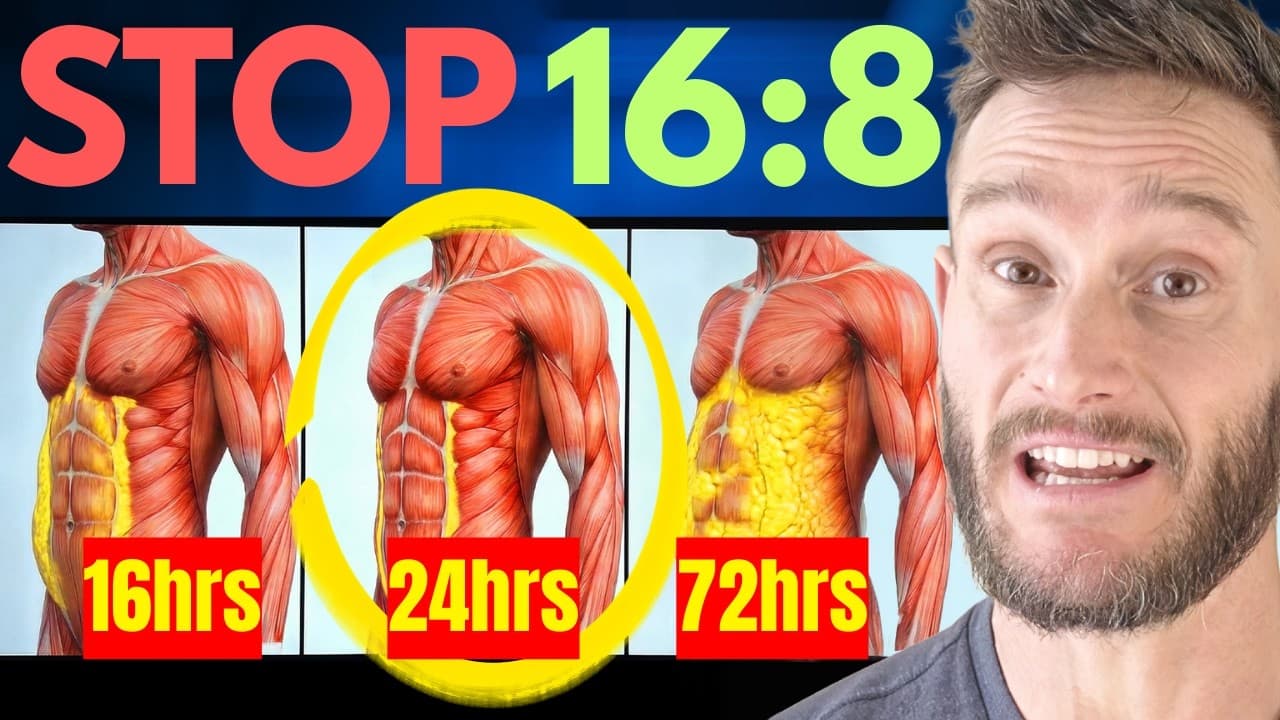
After six weeks of fasting 36 hours per week, visceral fat decreases more than overall body fat, and muscle mass does not decrease—it stays the same or increases.
Not enough evidence yet — take this with caution.
The balance between insulin and glucagon in the blood controls how much fat is broken down in human fat tissue.
Shows a real connection between these things — genuine evidence, though it can't prove cause and effect, and stronger studies could still change it.
Fat tissue around internal organs releases signaling molecules that directly reduce the body's ability to respond to insulin.
Evidence points in both directions — no clear conclusion yet.
Losing visceral fat reduces inflammation and restores normal insulin function, which improves overall metabolic health.
Shows a real connection between these things — genuine evidence, though it can't prove cause and effect, and stronger studies could still change it.
Metabolically healthy obesity is a temporary condition in which high insulin levels compensate for metabolic dysfunction, eventually leading to worsening metabolic health.
Evidence contradicts this claim.
Persistently high insulin levels lead to impaired metabolism and increased fat storage, while short-term increases in insulin stimulate the building of muscle protein.
Multiple causal studies (randomized trials and reviews) support this claim.
Insulin reduces the breakdown of stored fat into fatty acids by inhibiting an enzyme called hormone-sensitive lipase.
Multiple causal studies (randomized trials and reviews) support this claim.
In young people, insulin resistance and obesity develop as a result of long-term consumption of high-calorie, low-nutrient foods and low levels of physical activity.
Multiple causal studies (randomized trials and reviews) support this claim.
People who regularly consume added sugars and sugar-sweetened beverages have a higher rate of developing type 2 diabetes compared to those who do not.
Multiple causal studies (randomized trials and reviews) support this claim.
Key Takeaways
Summary
Based on the video transcript only.
- 1Problem: Most people are insulin resistant, so their bodies can't burn fat even when they eat less.
- 2Core methods: Do a 36-hour fast once per week for six weeks, move actively during the fast, and train with resistance exercises.
- 3How methods work: Fasting for 36 hours empties sugar stores in the liver, which drops insulin levels and turns on fat-burning mode; movement during the fast forces the body to use fat for energy.
- 4Expected outcomes: In six weeks, you lose half your body fat and 60% of your dangerous belly fat, while gaining 1–2 pounds of muscle.
- 5Implementation timeframe: One 36-hour fast per week for six weeks total, with no calorie counting needed on other days.
Related videos

Thomas DeLauer
You’ll Never Get Hungry During a Fast Again (16 Hours or More)

Thomas DeLauer
The Literal Best Source of Protein for Losing Fat and Building Muscle (hands down)

Thomas DeLauer
This Makes Sedentary People Lose Belly Fat (without exercise)

Thomas DeLauer
They Were Wrong About Fasting (this study misled us)

Thomas DeLauer
They Tried to Ban NAC… (because it works)
Thomas DeLauer